
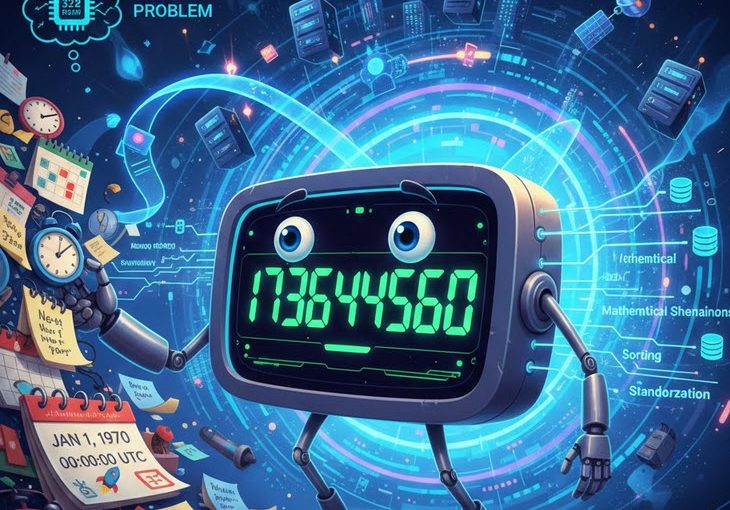
Ever feel like your computer is secretly judging your archaic notions of “Tuesday” or “December”? Well, it probably is. While you’re over here with your quaint “day-month-year” shenanigans, your digital overlords are speaking a much cooler, much simpler language: Epoch Time.
And no, it’s not some newfangled fitness tracker or a brand of fancy olive oil. It’s the numerical bedrock of digital time, and it’s surprisingly fun once you get past the initial “Wait, what’s a Unix?” phase.
The Big Bang of Digital Time: January 1, 1970
Imagine, if you will, the vast, empty expanse of the internet before time began. No tweets, no cat videos, just… silence. Then, with a digital “POP!”, came January 1, 1970, at precisely 00:00:00 Coordinated Universal Time (UTC). This, my friends, is Epoch 0. The ground zero. The primordial ooze from which all digital timestamps would spring.
It’s like the universe decided, “You know what? Let’s start counting from now.” And boy, did it ever start counting.
What the Heck is an “Epoch Time” Number?
When you see a number like 1707767340 (which, by the way, is roughly when I’m writing this), your human brain recoils in horror. “Is that a phone number? A zip code from the future? My credit score after a particularly bad online shopping spree?”
Nope. It’s just the total number of seconds that have passed since January 1, 1970, 00:00:00 UTC. That’s it. No months, no days, no pesky daylight saving adjustments. Just a relentless, ever-increasing count of seconds.
Think of it like a giant, cosmic stopwatch that started ticking on that fateful day in ’70 and just hasn’t stopped. It’s gloriously simple, terrifyingly precise, and utterly baffling to anyone who prefers their dates with a side of “leap year.”
Why Do Computers Love This Nonsense? (And Why You Should Too, Sort Of)
You might be thinking, “This sounds like a needlessly complicated way to say ‘Tuesday.'” And you’d be right, for humans. But for computers, it’s like finding a cheat code for time management.
- Mathematical Shenanigans (The Good Kind): Want to know how much time passed between your last online order and your current moment of existential dread? Just subtract one large number from another large number. BAM! Instant duration. Try doing that with “last Friday at 3:17 PM” and “next Tuesday at 10:05 AM.” You’d need a whiteboard and a very patient monk.
- Order! Order! (In the Digital Court): Imagine sorting a million events by their human-readable date strings. “January 1st, 2023” vs. “December 31st, 2022.” It’s a linguistic nightmare for a machine. But with Epoch time, it’s just sorting numbers. Smallest number = earliest event. Easiest decision ever.
- The Universal Translator of Time: Epoch time is always UTC. It doesn’t care if you’re sipping tea in London, eating tacos in Mexico City, or sleeping through your alarm in Tokyo. This eliminates all those messy “timezone conversion” headaches that plague global systems. It’s the one true time for all servers, everywhere.
- The Digital Paper Trail: Every login, every click, every server error is stamped with an Epoch timestamp. It’s the digital equivalent of a notary public, ensuring a precise, unalterable record of when things happened. Great for debugging, not so great for claiming you “didn’t see that email” when the timestamp clearly says you opened it at 2:37 AM.
The Looming Spectre of 2038 (Don’t Panic, Yet)
Ah, but nothing is perfect in the digital realm. Meet the Year 2038 Problem. Back in the day, many systems stored Epoch time using a 32-bit integer. That’s a fancy way of saying “a number with a limited amount of space.”
On January 19, 2038, at 03:14:07 UTC, that 32-bit number will hit its absolute maximum. And then? It’s going to “overflow” and wrap around, making computers think it’s actually sometime in 1901. Imagine your self-driving car suddenly thinking it’s traveling through the Wild West. Yikes!
Fortunately, most modern systems are built with 64-bit integers, which can count seconds for billions of years. So, unless you’re still running your grandmother’s Pentium II as a server, you’re probably safe. For now.
In Conclusion: Embrace the Seconds
So, the next time you marvel at how quickly an online transaction processes or how perfectly synced your global video call is, spare a thought for the humble Epoch time. It’s the unsung hero, the silent counter, the relentless tick-tock that keeps our digital world perfectly in sync.
It might not make sense to us to say “I’ll meet you at 1736945760,” but for the vast, interconnected network of machines, it’s the only time that truly matters.